
Powered
by you.
How an automatic watch works
Your wrist gives it energy. A spring saves it. A tiny balance sets the rhythm. Follow the journey inside an automatic watch, one pencil drawing at a time.
Follow the energy
01 / WINDThe rotorGathers energy from your movement.
02 / STOREThe mainspringStores it for the hours ahead.
03 / REGULATEBalance & escapementGive the movement its rhythm.
Your movement starts everything
Reach for your morning coffee. Pull on a jacket. Close a door. Inside your watch, a small weight responds to these ordinary gestures. Before you have thought about the time, you have already given the movement a little energy.
An automatic watch winds its mainspring using movement of the wrist. The spring powers a train of gears; a balance and escapement regulate their advance. In a conventional automatic mechanical watch, this happens without a battery. Here is the journey, from the first swing of the rotor to the next step of the seconds hand.
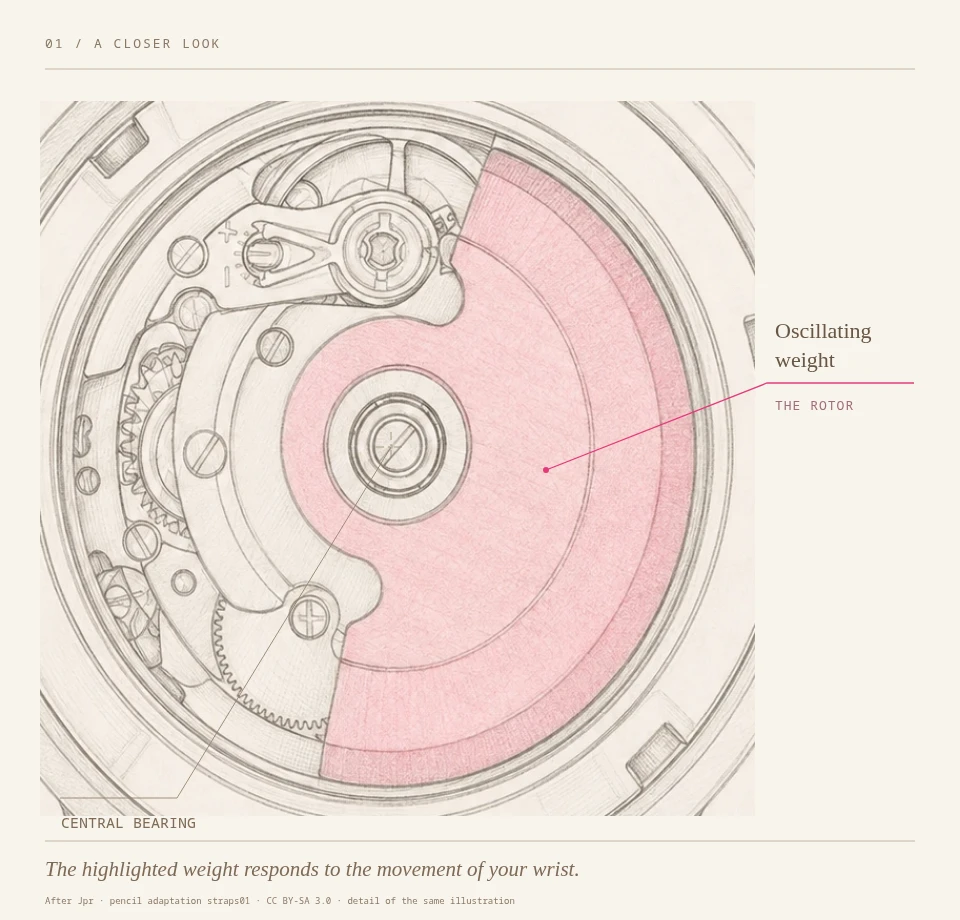
The raspberry part in our opening drawing is the rotor, also called the oscillating weight. Its off-centre mass lets it swing around a bearing as the watch moves. Gears connect it to the winding system, which transfers that motion to the mainspring.
The illustrated ETA 2824-2 winds in both directions. Other automatic calibres wind in just one, so a rotor that spins freely one way is not necessarily faulty. Through a transparent caseback, the broad moving weight is often the first component you notice.
Look beyond it and you may spot another moving wheel. That is the balance, much smaller and much faster. The rotor gathers energy from your day. The balance helps decide the rhythm at which the watch spends it.
A spring stores your day
Your wrist does not drive the hands directly. Between the winding system and the gear train sits a long, flat strip of spring metal, coiled inside a drum called the barrel. This mainspring is the movement's energy store.
Winding tightens the spring around its central arbor. As the spring releases its stored energy, it turns the barrel. Teeth around the barrel drive the next wheel, passing power into the gear train. The gears transmit motion at the ratios needed to display seconds, minutes and hours.
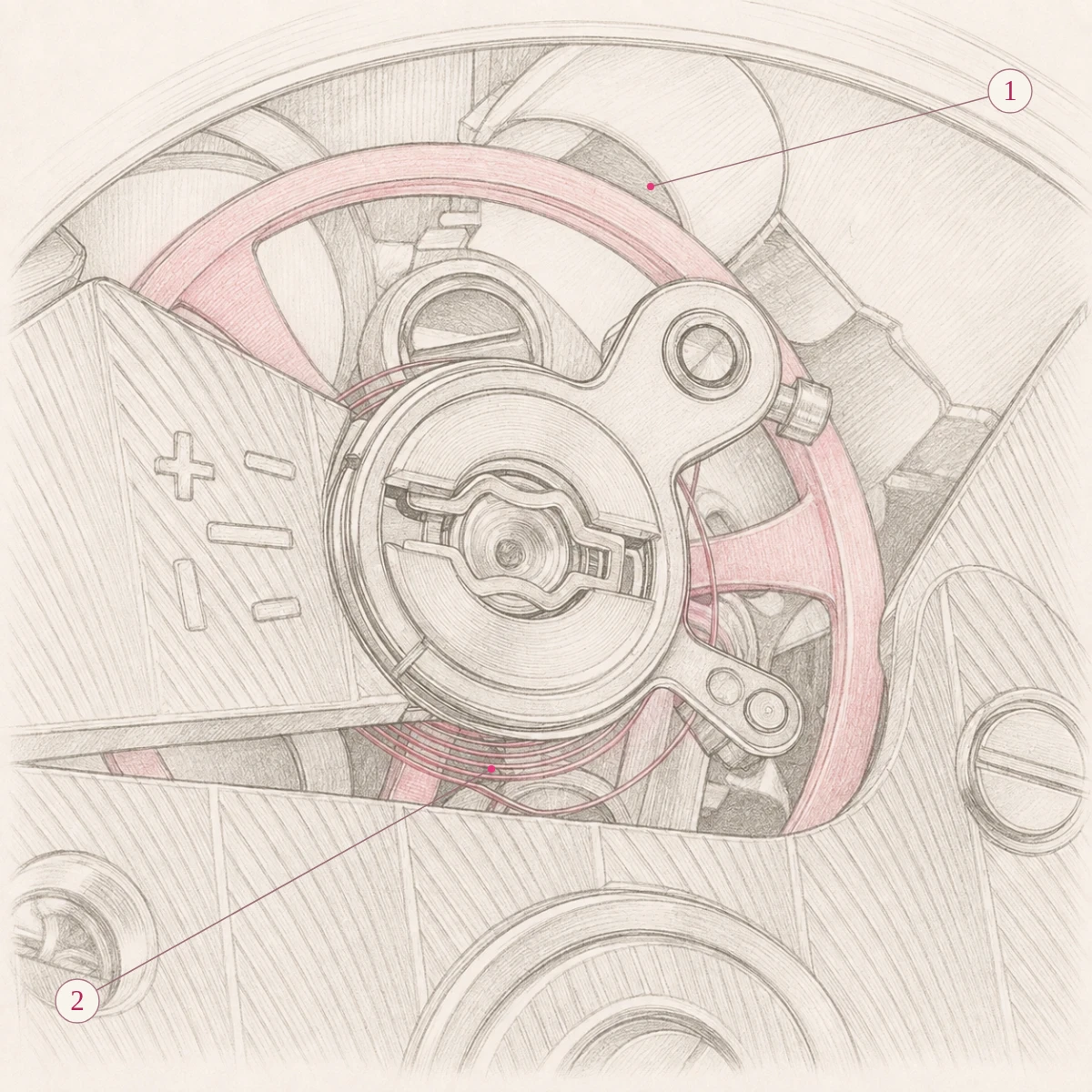
In the drawing, follow the tightly packed raspberry lines through the openings in the metalwork. They are the visible edges of one coiled ribbon, not separate rings. This skeleton movement makes the spring visible; in many watches, a solid barrel lid conceals it.
You supply the movement.
The spring saves a little of it for later.
Winding adds energy. Running uses it. Both can happen while you wear the watch, and running can continue after the rotor becomes still. Automatic mainsprings commonly use a slipping attachment at the barrel wall so the winding system can continue operating when the spring is fully wound.
There are two very different springs in this story. The mainspring powers the movement. The much finer hairspring, attached to the balance, helps establish its rhythm. Remember that distinction as we move closer.

Meet the heartbeat
Now look for a wheel that turns one way, stops, and returns. Unlike the rotor, the balance does not normally make continuous revolutions. It oscillates around its central staff, working with the fine spiral attached to it.
As the balance moves away from its resting position, the hairspring provides a restoring force. The wheel passes back through the centre and swings in the other direction. The balance's inertia and the spring's properties establish the natural rhythm of this oscillator.
Our drawing highlights the balance rim and the visible hairspring beneath the central support. The broad circular metal surface on top is part of the supporting assembly: its concentric machining marks are not the hairspring. The actual spring is the fine set of separated curves below it.
The balance loses energy to friction and other resistance, so it needs small impulses to keep oscillating. Those arrive through the escapement. Think of a pendulum receiving a gentle, well-timed push: the push sustains the motion while the oscillator sets the pace.
For the ETA 2824-2 in our opening, that pace is 4 Hz: four complete back-and-forth oscillations per second. Each full oscillation contains two beats, giving eight beats each second, or 28,800 vibrations per hour. Other calibres run at other frequencies; this is one example.
A little release. A little push.
A wound spring and a gear train would run down rapidly without a way to control their motion. The lever escapement connects that source of power to the oscillator. Its job has two sides: restrain the gear train, and keep the balance moving.
The escape wheel receives power from the train. Its specially shaped teeth meet two small pallet stones carried by a lever, also called the pallet fork. One pallet locks the wheel while the balance continues through most of its swing.
As the balance returns towards the centre, its impulse jewel engages the fork and moves the lever. The locked tooth is released. As the escape wheel advances, it transfers energy through the lever to the balance; the opposite pallet then locks the wheel again. The sequence repeats on the return swing.
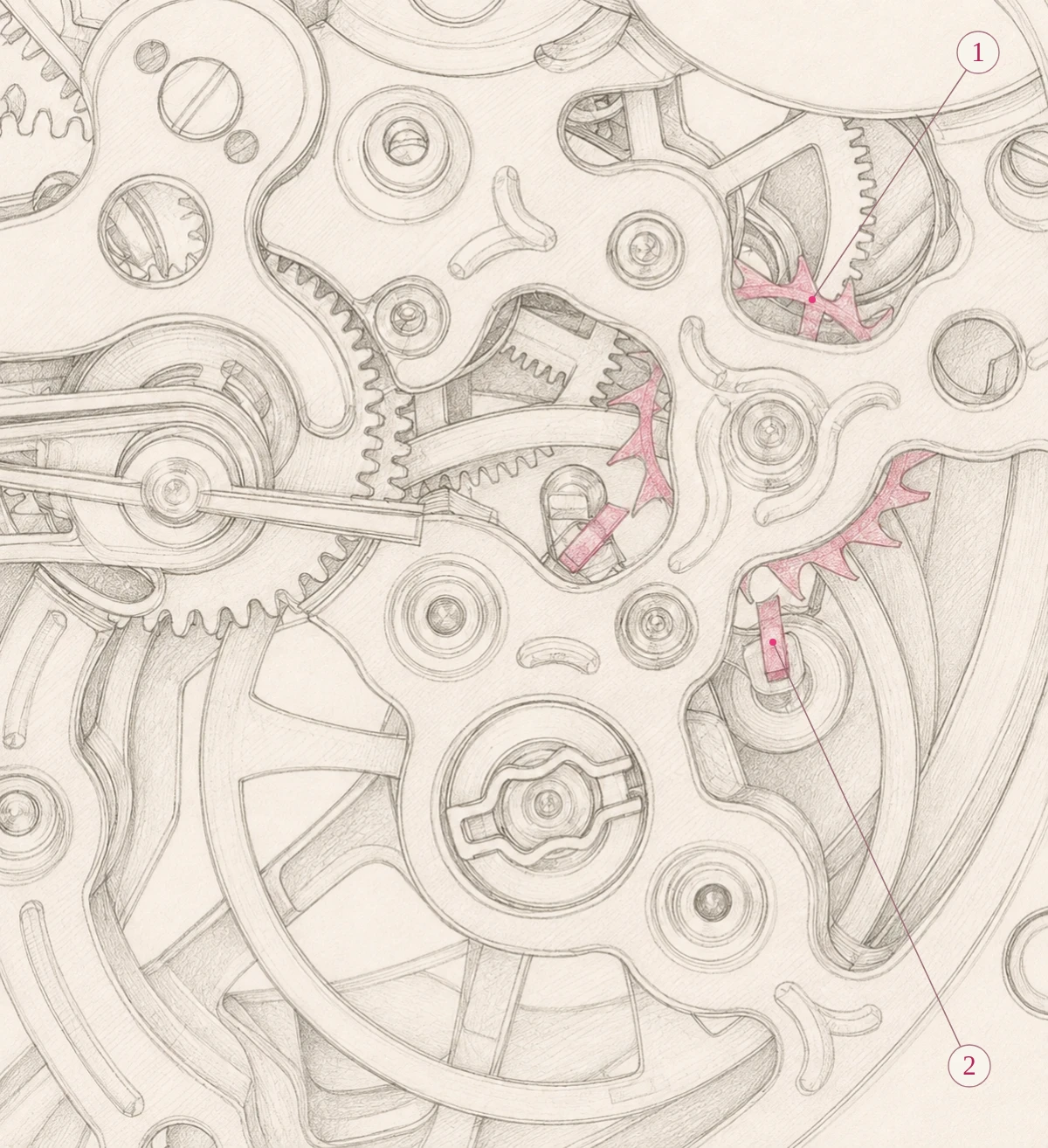
In the illustration, the highlighted teeth and two pallet stones appear between the bridges. Some connecting parts are hidden in the original photograph and remain hidden in the drawing. These are observed details of a real lever mechanism, not an invented exploded assembly.
That repeated locking and release is behind the familiar tick. On many mechanical watches, the seconds hand appears to sweep because its small advances happen several times a second. With the 4 Hz example above, there are eight beats in the time it takes to say “one”.
When the world goes quiet
Set the watch down at night. The rotor comes to rest, but the mainspring still holds energy. The train, escapement and balance keep working. The time a fully wound watch can continue running is its power reserve.
There is no universal reserve for automatic watches. ETA lists a typical 42 hours for the 2824-2. Seiko specifies about 41 hours for the 4R35 and 4R36 in its winding instructions. Other movements offer different reserves; check the specification of your exact watch.
Those figures assume a fully wound movement. A short walk or a quiet day at a desk may add less energy than you expect. Time on the wrist does not guarantee that the spring has reached its full reserve.
If the watch stops after several days unworn, it may simply have used its stored energy. Restart it according to its instructions. Repeated stopping despite appropriate winding, or a marked change in timekeeping, is a reason to have it checked by a qualified watchmaker.
Living with an automatic
The mechanism is intricate. Your routine can be simple: learn your watch's controls, wear it comfortably and follow its manufacturer instructions when winding or setting it.
Starting a stopped watch
Many automatic calibres allow crown winding, but some do not. Where supported, use the specified crown position and winding direction. Release a screw-down crown before operating it and secure it afterwards. A fixed number of turns is not a rule for every watch.
Set the time and calendar using the manual. Some date mechanisms restrict quick adjustment during particular hours. These drawings explain what happens inside; normal winding and setting do not require opening the case.
Getting to know its rhythm
Position, temperature and state of winding can influence a mechanical watch's rate. Observe it over normal use rather than expecting every day to be identical. Its stated accuracy range and service instructions are more useful than a comparison with someone else's different calibre.
“Automatic” describes the winding system of a mechanical watch. A hand-wound mechanical watch relies on winding by its wearer. Quartz uses a different regulating principle: our guide to how a quartz watch works follows that other route from energy to timekeeping.
The same watch, your character
Now the familiar object on your wrist has another dimension. Behind the hands, you can picture the swinging weight, the stored energy and the tiny exchanges that sustain its rhythm. The movement stays with you; its strap can change with your day.
Start with fit. Measure the distance between the lugs using our guide to measuring lug width. Case shape, spring bars and clearance matter too, especially with curved ends and one-piece straps.
Leather brings a different texture from woven textile or metal. Choose for comfort, suitable use and the character you enjoy. A new strap changes how the watch feels to wear, without changing the mechanism you have just explored.
Our illustrated strap-changing guide explains conventional spring bars, quick-release bars and one-piece straps. Protect the watch while working, then check that both ends are secure.
Explore watch straps for your next mood. Keep the little machine that means something to you. Give it another place in your day.
One more thing
A few good questions.
Does an automatic watch need a battery?
A conventional automatic mechanical watch uses a mainspring for energy and a balance with an escapement to regulate time. It does not need a battery. Other technologies, including Spring Drive and kinetic quartz systems, work differently.
Why does my automatic watch stop when I do not wear it?
It continues on the energy stored in its mainspring until that reserve is exhausted. Restart it using the instructions for your watch. A short time on the wrist may not fully wind it.
Can I wind an automatic watch by hand?
Many automatic movements support crown winding, but some do not. Check the instructions for your calibre, including crown position, winding direction and any screw-down crown procedure.
What is the difference between the rotor and the balance?
The rotor responds to movement of the watch and supplies energy to the winding mechanism. The balance oscillates with its hairspring and works with the escapement to regulate the movement.
What does 28,800 vibrations per hour mean?
It means eight beats each second. Because a full back-and-forth oscillation contains two beats, this corresponds to a frequency of 4 Hz. The ETA 2824-2 is one example; other mechanical movements use different frequencies.
Stay curious.
Mechanics 3 min read
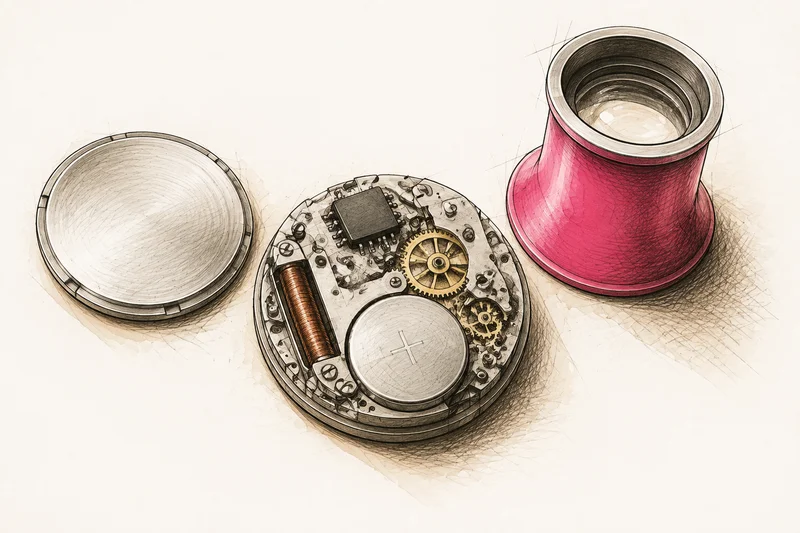
The simple science of quartz watches
Learn how a battery, a tiny crystal and a simple circuit work together to keep your quartz watch running with highly reliable accuracy every day.
History 7 min read
Hamilton Murph: a watch with a story to tell
From Interstellar to everyday life: the story behind the Hamilton Murph 42 mm, the detail hidden on its seconds hand, and how to choose a strap that makes it yours.
History 3 min read
Strap guide for the Rolex Datejust 36
Learn how to choose the correct strap for your Rolex Datejust 36 by understanding its case dimensions, lug width, and different material options.