Tutorial 6 min read
How to change a watch strap
Identify the attachment, release the correct part and check that both tips are seated. Illustrated instructions for quick-release bars, conventional bars and nylon pass-through straps.
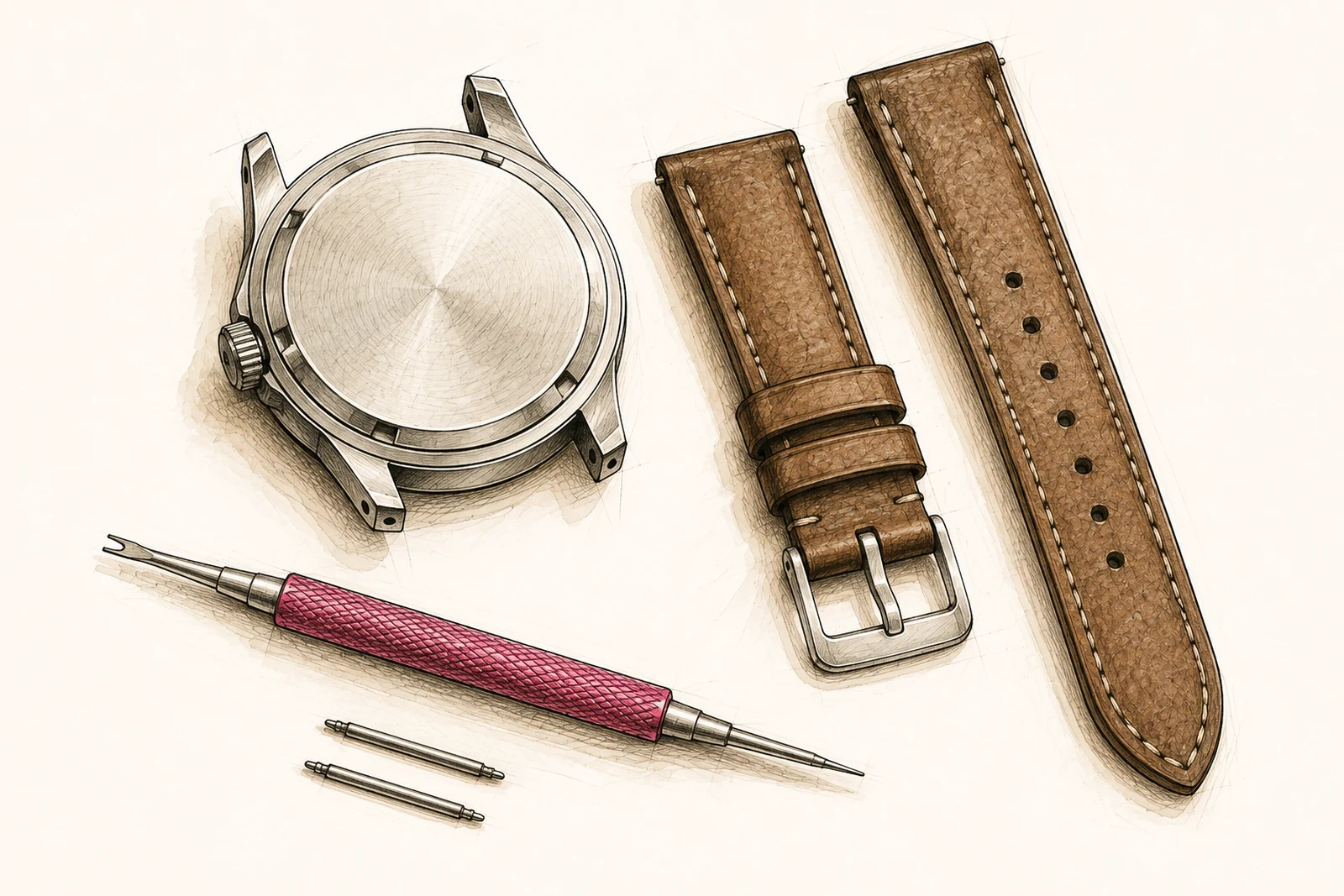
A strap change is a small mechanical job: release a spring-loaded tip, control the loose parts, then confirm that both tips have seated again. The right method depends on the attachment. Start by turning the watch over and identifying what holds the strap.
Identify the attachment and prepare
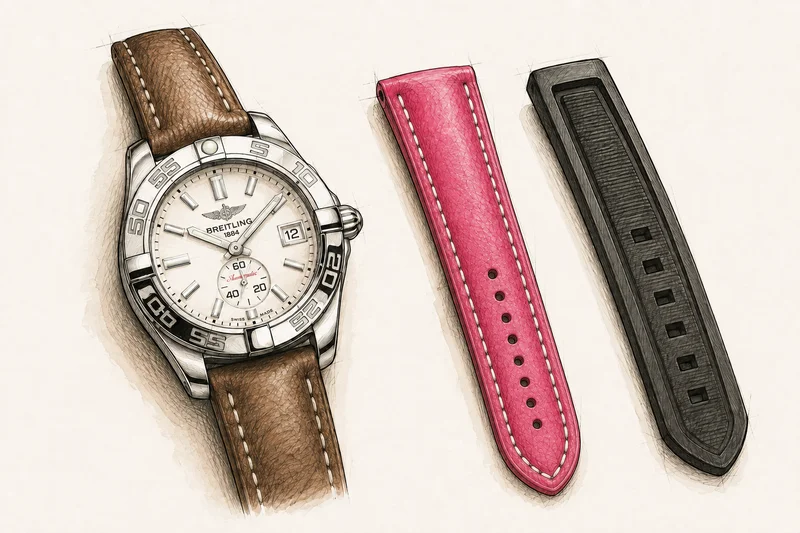
- Quick release: a small lever projects through a slot on the underside of the strap.
- Conventional spring bar: no lever; a forked tool engages a shoulder near one end of the bar.
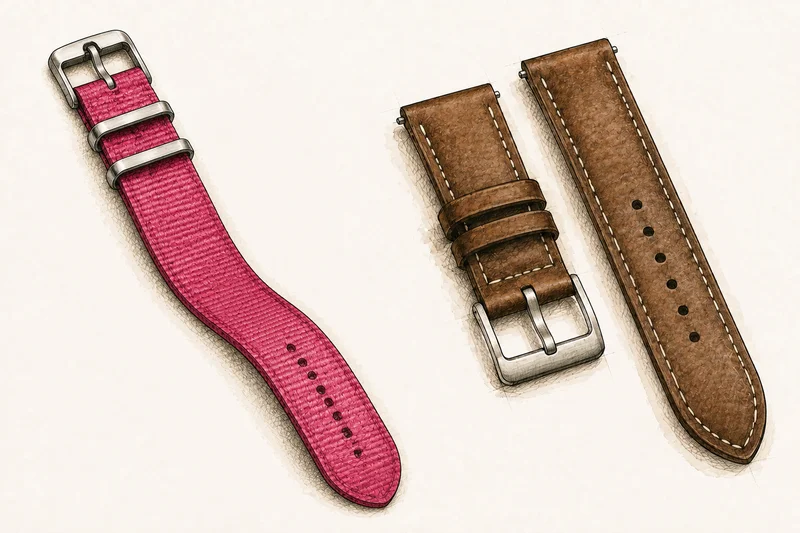
- Pass-through strap: one continuous strip runs behind the case, through the gaps between case and bars.
This guide covers ordinary spring-bar fittings and flexible nylon pass-through straps. Screws, fixed bars, proprietary release buttons and integrated bracelets need their own instructions. If you cannot identify the attachment, do not try to prise it out.
Put the watch face down on a clean, soft mat, with the crown free of pressure. Keep a small tray for bars. For conventional bars, use a correctly sized spring-bar tool and protect the lug backs with suitable removable protective tape. Tape reduces accidental contact; it cannot make a slipping tool harmless. WatchGecko's fitting guide shows a rear-side approach.
Remove a quick-release strap
- Support the watch and hold the strap close to its attachment.
- Slide the lever along the spring bar, towards the centre of the strap's width. Do not pull it down the length of the strap or away from the leather.
- Hold the lever retracted. Once that tip clears its lug hole, ease that end of the strap out towards the caseback side.
- Withdraw the other tip and lift the strap away. Repeat for the other half.
The lever moves one tip; the bar's outer tube stays in the strap. HIRSCH's quick-release instructions demonstrate this inward sliding action. If the tip does not clear, check the lever's travel and the fitting instead of pulling harder.

Remove a conventional spring bar
From the back of the watch, locate the bar's shoulder between the strap and the inner lug face. Engage the fork on that shoulder. Compress it inward along the bar's axis, keeping the tool under control. Do not use the lug as a fulcrum to lever the bar out.
Keep the spring compressed until the tip is clear of the hole, then guide that end out towards the caseback side. Hold the bar so it cannot fly away; withdraw the opposite tip. Work on one strap half at a time.
On a compatible watch with drilled lugs, a correctly sized pin end can depress the spring-bar tip through the outside hole. That is a different access point, not protection against scratches. Do not push on a screw head or force a tool into a hole it does not fit.

Fit and check a two-piece strap
First confirm the lug width and the correct bar specification for the watch and strap. Spring bars differ in body diameter, tip diameter, end shape and length. The diameter of the main tube is not the diameter of the pin entering the lug. Esslinger's hardware diagrams illustrate these differences. Retain suitable original bars if the replacement strap permits, and replace bent, corroded or sticking bars with the correct specification.
For a conventional pin-buckle strap, the short buckle half normally goes at 12 o'clock and the longer hole half at 6 o'clock. Follow the maker's orientation for a folding clasp or special strap.
- Seat one tip in its lug hole.
- Retract the opposite tip with the quick-release lever or the fork on the shoulder.
- Bring that end between the lugs, align it with the second hole, then release the spring gently.
- Check that both tips have entered their holes. A tip resting against a lug face can look fitted; a click alone is not confirmation.
With the watch supported over the mat, give each strap half a gentle, controlled pull near its attachment and inspect both ends again. If a tip slips out or you cannot confirm engagement, refit it before wearing. WatchGecko's leather-strap guide also describes seating one end before compressing the other.

Thread a nylon pass-through strap
Remove the two-piece strap, then refit and check both bare spring bars. With the dial facing you and the buckle towards 12 o'clock, feed the free end between the 12 o'clock bar and the case, from the dial side to the back. Carry it across the caseback, then through the 6 o'clock gap from the back to the dial side.
For a traditional NATO with a short secondary section, continue through the keeper at the end of that section and settle the watch between the retaining hardware. A single-pass strap omits that secondary section. Follow the threading sequence supplied with your particular design; Crown & Buckle's fitting instructions show the nylon NATO sequence.

Matching width is not enough: the material needs clearance between each bar and the case. Never force a thick strap through a tight gap. Some leather or close-fitting pass-through straps must be positioned with the bars removed and the bars refitted afterwards; follow the strap maker's method.
Before putting the watch on
Check both attachments, the buckle or clasp, and the condition of the strap around the bars. The ends should sit as intended without being crushed against the case. If a bar will not seat, a lever binds or the strap fouls the case, resolve the incompatibility rather than relying on extra force.
Once the fitting is confirmed, adjust the length and secure any loose tail in its keepers. Keep the removed bars labelled with their watch reference so they do not get mixed with similar-looking spares.
Questions
Do quick-release straps need a tool?
A conventional quick-release lever retracts its tip by hand. Slide it along the spring bar towards the centre of the strap width. Other proprietary release systems may work differently.
What spring-bar size do I need?
Use the specification appropriate to both the watch and strap. Length alone is insufficient: body diameter, tip diameter and end geometry also matter. The tube diameter is not the diameter of the tip entering the lug hole.
Can a NATO strap fit every watch of the same lug width?
No. The attachment and available clearance must suit the material. Never force a thick strap through a tight gap; some designs require removing and refitting the bars around the strap.
Which strap half goes at 12 o’clock?
For a conventional pin-buckle strap, the short buckle half normally goes at 12 o’clock and the longer hole half at 6. Follow the manufacturer’s orientation for folding clasps and special designs.
Is a click enough to confirm the bar is fitted?
No. Confirm that both tips are seated, then gently check each strap half with the watch supported over a soft mat. A tip resting against a lug face can appear fitted without entering its hole.
Sources & further reading 5
The next chapter