
A small window into a long story
There is a lot to look at on a Datejust 31. Light breaks across the bezel, the bracelet repeats its tiny pattern of links, and the date sits beneath a lens that refuses to disappear into the dial. In a compact case, those details feel close together and deliberate. That is what interests us here: how much character a familiar design can hold at a smaller scale.
The story begins with the Datejust family in 1945, rather than with this particular size. Rolex brought together an automatic movement, a waterproof chronometer wristwatch and a date window at three o'clock. Its historical account dates the instantaneous date change to 1956. A function now easy to take for granted became part of the watch's identity.
Looking at the 31 through that lens makes more sense than treating it as a scaled-down specification sheet. It is a particular way of wearing the Datejust idea.
Three details that hold the eye
Start with the Cyclops. Rolex introduced the magnifying lens in 1953, placing it over the date window. The brand's account of the lens explains its purpose: easier reading. Visually, we see something else too. The raised shape interrupts an otherwise orderly circle and gives your eye somewhere specific to land.
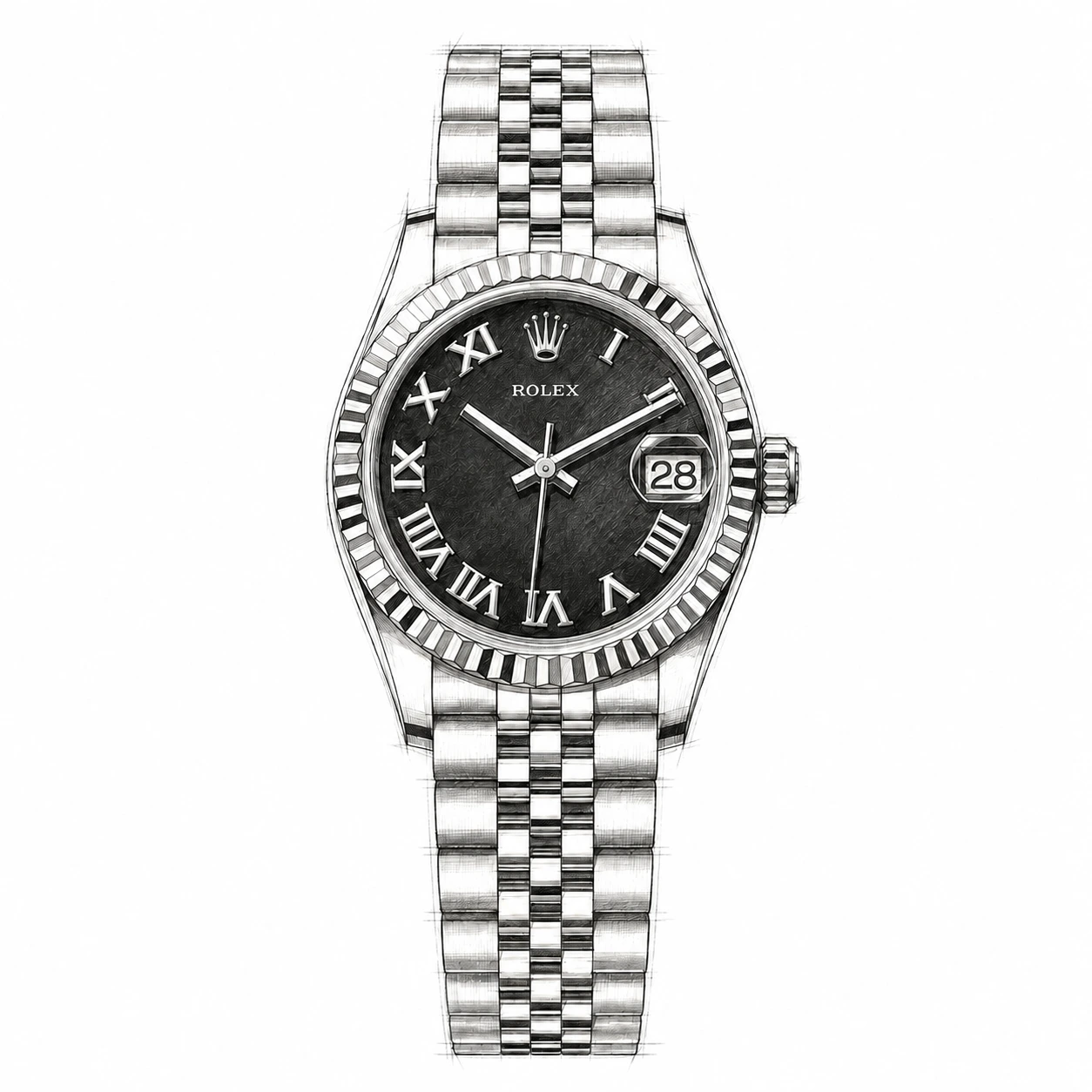
Then look at the fluted bezel. In our reading of the design, its alternating edges make a quiet dial feel more animated. Draw the watch in pencil and that contrast becomes especially clear: a dark central surface surrounded by short, sharply changing strokes.
Finally, follow the bracelet away from the case. The five-piece-link Jubilee repeats a finer rhythm than the larger three-piece-link Oyster. Rolex created the Jubilee for the Datejust's 1945 launch; today, the collection includes both designs, depending on the configuration. Our preference is a styling choice: Jubilee for a continuous shimmer, Oyster for a stronger visual frame.
31 mm is its own proportion
A smaller watch leaves more wrist visible around the case. That can change the balance of an outfit as much as dial colour does. With the Datejust 31, we would begin by looking at the whole silhouette: case, bracelet, wrist and sleeve together. A diameter is a useful starting point; it cannot tell you how that combination will feel.
It also helps to keep the names straight. The current Datejust 31 and Lady-Datejust 28 are distinct sizes. Rolex traces the Lady-Datejust to 1957 and records its move to 28 mm in 2015 in the Lady-Datejust history. Those dates should not be reused as launch dates for the 31.
Try the size because you like its proportions. Labels such as small, mid-sized or ladies' are less useful than seeing whether the dial remains easy for you to read and the bracelet sits where you want it.
A familiar shape, a newer generation
Continuity in the dial does not mean everything underneath stayed the same. Rolex's 2018 presentation introduced a new Datejust 31 generation in 18 ct gold, with revised case sides and lugs and calibre 2236. In 2019, yellow and Everose Rolesor versions followed with that movement.
For a present-day example, our drawings take their exterior cues from 278274-0002. Its official specification provides a precise reference point:
| Detail | 278274-0002 |
|---|---|
| Case | 31 mm, Oystersteel and white gold |
| Dial and bezel | Bright black; fluted bezel |
| Movement | Self-winding calibre 2236 |
| Power reserve | Approximately 55 hours |
| Crystal | Sapphire with Cyclops lens |
| Bracelet | Jubilee with concealed Crownclasp |
Use that reference when reading these figures. An older Datejust 31 should be identified on its own terms; the current model's movement and specifications are not a retrospective specification for the entire family.
The quiet work behind the dial
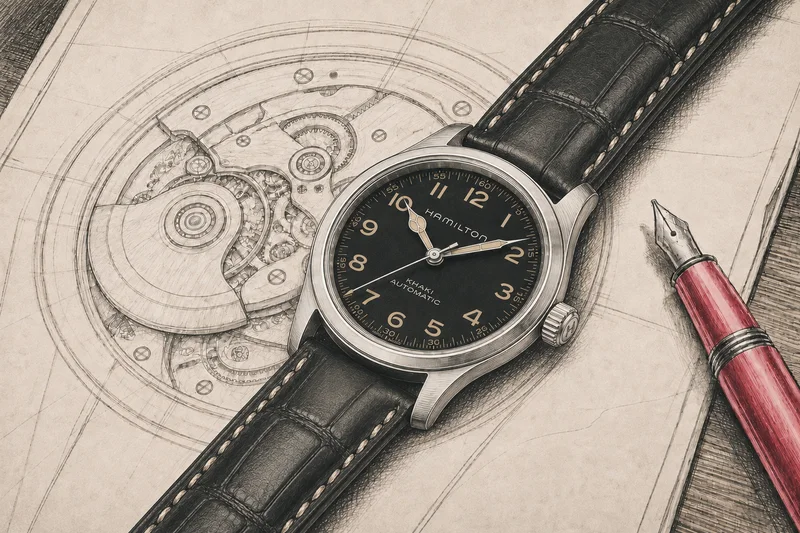
The hands offer a simple display while an automatic mechanism works beneath them. In Rolex's description of the movement, the Perpetual rotor uses wrist movement to wind the mainspring. Stored energy keeps the watch running when it is taken off.
That relationship is part of the appeal of a mechanical watch: wearing it contributes to its operation. For us, the contrast with the decorative exterior is compelling. A bezel can catch the light immediately; a small winding system does its work out of sight.
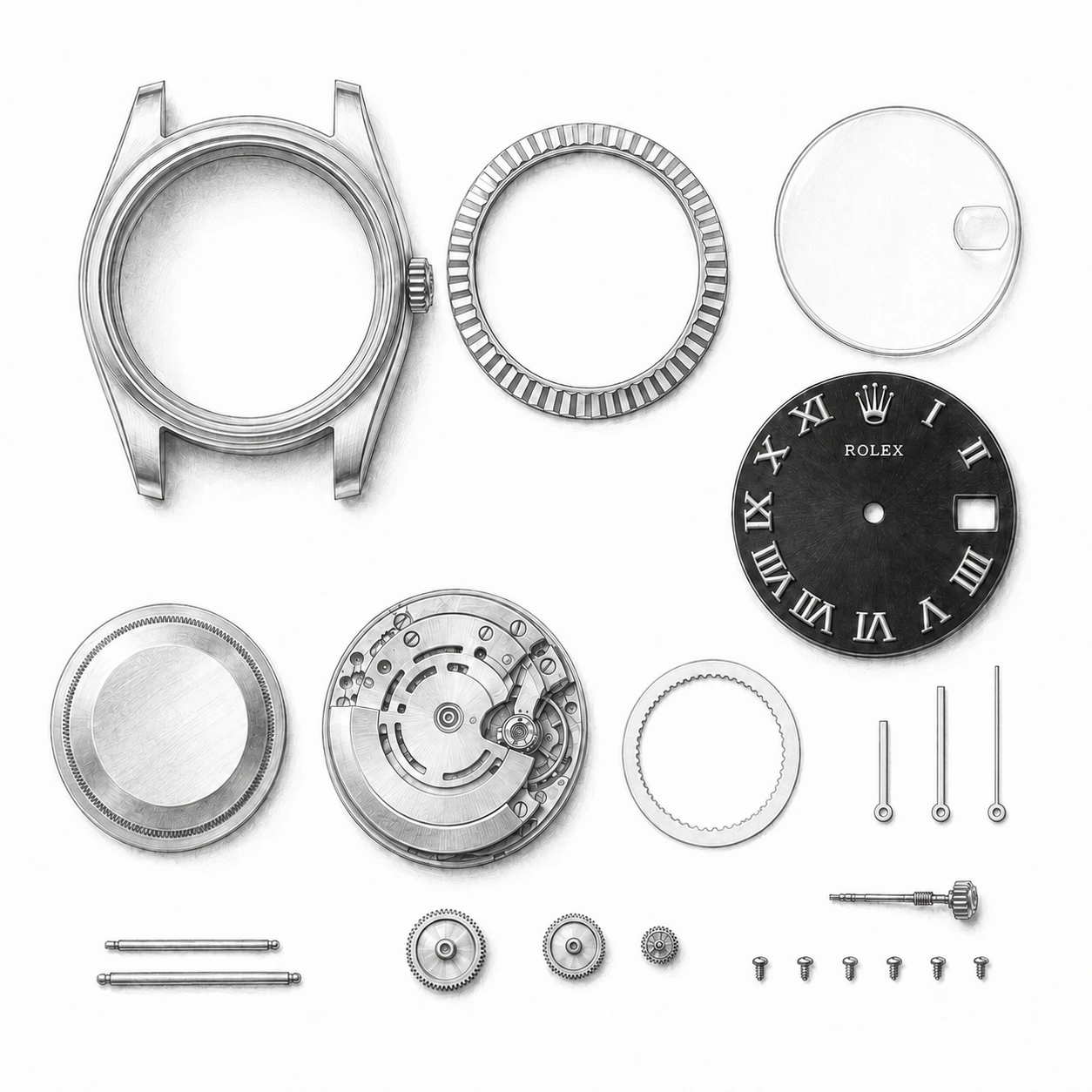
The study alongside this chapter follows the Datejust's exterior and the forms of Rolex's photographed calibre 2236, keeping the mechanism largely assembled. The separate case, bezel, crystal, dial and small fittings give a closer sense of how much sits behind that familiar face.
Let the strap change the emphasis
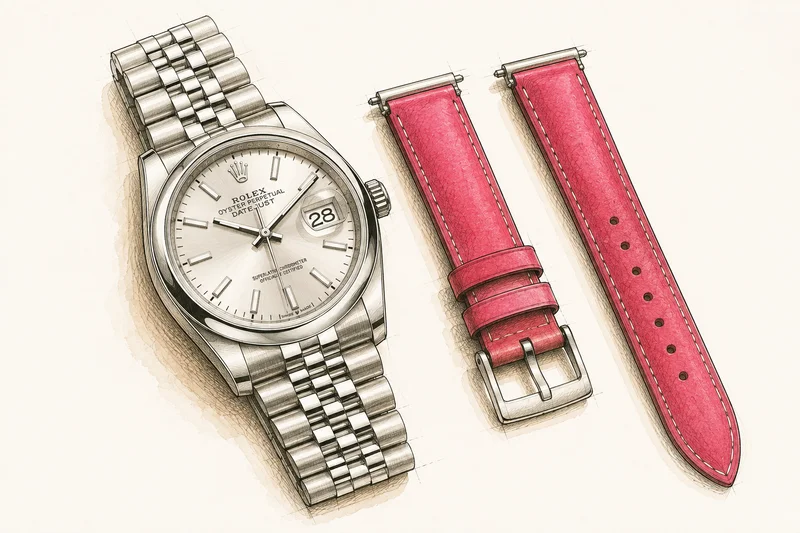
A strap can move attention back towards the dial. Our first styling experiment would be smooth black leather with restrained stitching: a quieter surface beside the bezel. Dark brown gives the same face a warmer setting. A muted grey can keep the palette close to the steel while softening the change of texture.
Confirm the fit before choosing the colour. The 31 mm case diameter is not a strap measurement. Identify your exact reference, measure the space between its lugs, and check the spring bars, attachment clearance, strap thickness and length. A shared width alone does not establish compatibility with a particular case.
Our lug-width guide explains where to measure. If your verified measurement is 16 mm, the 16 mm selection is a starting point for browsing, subject to the remaining fit checks. If you are unsure about removing the bracelet, ask a watchmaker to identify the fitting.
Care changes with the material too. Rolex's care guidance excludes leather straps from its soapy-water cleaning advice. Follow the replacement strap maker's care instructions.
The details you choose to keep
You do not have to change the Jubilee for the Datejust 31 to feel personal. Keeping the original bracelet can be the most satisfying choice when its pattern is part of what drew you to the watch.
Or let a softer strap quieten the edges and make the dial the centre of attention. Either way, start with the feature you enjoy most. The date lens, the fluting, the Roman numerals, the compact silhouette: this is a watch with several points of entry. Your combination decides which one leads.
Questions
Was the Datejust 31 introduced in 1945?
1945 is the launch year of the Datejust family. It is not a launch date for the 31 mm version. This story separates the family history from the modern Datejust 31 generation documented in Rolex's 2018 announcement.
Is the Datejust 31 the same as the Lady-Datejust?
No. The current Datejust 31 has a 31 mm case; the current Lady-Datejust has a 28 mm case. Identify the exact reference when comparing specifications and fittings.
Which movement does the watch in this story use?
Rolex lists the illustrated reference 278274-0002 with self-winding calibre 2236 and approximately 55 hours of power reserve. Check older references separately.
Which strap width should I buy?
Confirm your reference and measure its lug gap. Do not use the 31 mm case diameter as the strap width. If the measured gap is 16 mm, start with that width, then verify spring bars, case clearance, thickness and length.
Sources & further reading 8
- Rolex Newsroom: Datejust history and current collection
- Rolex: the Cyclops lens, introduced in 1953
- Rolex Newsroom: the separate Lady-Datejust history
- Rolex: 2018 Datejust 31 presentation (PDF)
- Rolex: 2019 Datejust 31 presentation (PDF)
- Rolex: Datejust 31 reference 278274-0002
- Rolex: care and cleaning FAQ
- Rolex: Datejust features and calibre 2236 photograph
The next chapter